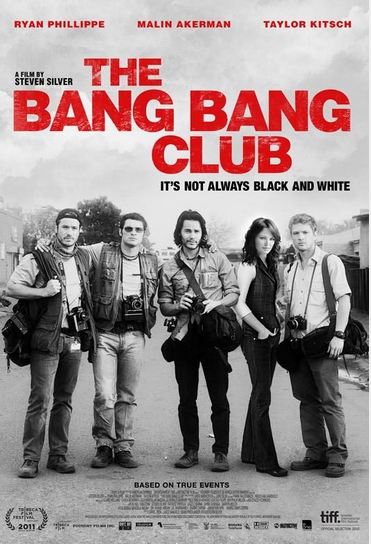
I was lucky enough to see
The Bang Bang Club (2011/Director:
Steven Silver) starring
Ryan Phillippe (Lincoln Lawyer, Breach) and Malin Akerman (The Romantics, Watchmen) recently and was blown away at how emotionally engaging this movie ended up being. Though I had read the book and knew the details of the story, beyond what I read in the book, it was still a movie that was worthwhile and entertaining. The Bang Bang Club movie is an adaptation of the book (
The Bang-Bang Club: Snapshots from a Hidden War) by photographers
Greg Marinovich and Joao Silva. The Bang Bang Club chronicles the four years leading up to the historic 1994 South African election, when the government and its sympathizers aimed to destroy Mandela's ANC movement. The movie portrays the lives of four photojornalists active within the townships of South Africa during the
Apartheid period (90-94), from when Nelson Mandela was released from jail to the 1994 elections. The South African general election of 1994 was an election held in South Africa to mark the end of apartheid.
The name "Bang-Bang Club" was born out of an article published in the South African magazine Living. Originally named the Bang-Bang Paparazzi, it was changed to "Club" because the members felt the word paparazzi misrepresented their work. In the movie there is an interesting scene where the photojouralists get very upset and emotional when they are challenged as being over hyped paparazzi's, just with guns aimed at them. The 'Bang Bang' name comes from the culture itself; township residents spoke to the photographers about the "bang-bang" in reference to violence occurring within their communities, but more literally, "bang-bang" refers to the sound of gunfire and is a colloquial form of nomenclature used by conflict photographers.
Told from Greg Marinovich's (played by Ryan Phillippe) point-of-view, the story takes us from the young photographer's (he was only in his late 20's at this time) chance meeting with three experienced veterans to his worldwide recognition and brash recklessness. Ryan Phillippe does a great job playing a young, inexperienced, but highly competent and agressive player. Phillippee is perfect for this role and with his personality and charisma he is the right guy to play the newcomer. As the lead charaters he portrays a slightly bold and confident, yet his face reveals fresh fear as he embarks on neighborhoods other photographers would never dare enter.
This film allows you to see multiple perspectives, from the warriors and victims of the war, to the publishers who are trying to play between the government, social unrest and their reader, oh yes and of course the always looming pulitizer award possibilities hanging over their heads.
As a photographer myself, although not even close to the level of these guys, it is clear from the movie that the Bang Bangs are not just photographers, but are so much more. You realize pretty early in the film that the Bang Bangs, willingly chose a profession that may well be the world's most dangerous non-criminal vocation. Is the thrill-seeking, voyeuristic element of war-zone photojournalism balanced out by its allegedly noble aims, or by the fact that the people who practice it take on all the risks of soldiering without carrying weapons?
The most compelling scene is the reenactment of the famous Kevin Carter Vulture photograph. Though many of the photos coming out of this terrible place gave us insights into a culture and world we could only imagine on the big screen, the Vulture photo takes the story to another level.
The history of this photograph is touched on in the film, though to give you more details I have included a little more of the background on this award winning photograph, and the horrid outcome.

In March 1993, photographer
Kevin Carter made a trip to southern Sudan, where he took now iconic photo of a vulture preying upon an emaciated Sudanese toddler near the village of Ayod. Carter said he waited about 20 minutes, hoping that the vulture would spread its wings. It didn’t. Carter snapped the haunting photograph and chased the vulture away. (The parents of the girl were busy taking food from the same UN plane Carter took to Ayod).

The photograph was sold to The New York Times where it appeared for the first time on March 26, 1993 as ‘metaphor for Africa’s despair’. Practically overnight hundreds of people contacted the newspaper to ask whether the child had survived, leading the newspaper to run an unusual special editor’s note saying the girl had enough strength to walk away from the vulture, but that her ultimate fate was unknown. Journalists in
the Sudan were told not to touch the famine victims, because of the risk of transmitting disease, but Carter came under criticism for not helping the girl. ”The man adjusting his lens to take just the right frame of her suffering might just as well be a predator, another vulture on the scene,” read one editorial.
Carter eventually won the
Pulitzer Prize for this photo, but he couldn't enjoy it. “I’m really, really sorry I didn’t pick the child up,” he confided in a friend. Consumed with the violence he’d witnessed, and haunted by the questions as to the little girl’s fate, he committed suicide three months later.
This movie is well worth your time and money. During the film when you see the actual famous photos come to life you are able to translate not only what was in the photos, but what was behind the lens and the depth and complexities of the stories that went into these amazing times. If anything else, this movie does a great job of educating and exposing the risks that journalists take to bring these types of photos to the world, and how the risks are not short term or just physical, but can last forever.
An excellent book has been transformed in to an excellent film, albeit a film that is harrowing to watch unfold.